
Mera Peak Climbing
Share with your friends
Trip Information

Duration
17 days

Max Altitude
6,476 M

Difficulty
Very Strenous

Starts from
Kathmandu

Trips Ends at
Kathmandu

Activity



Mera Peak Climbing Overview
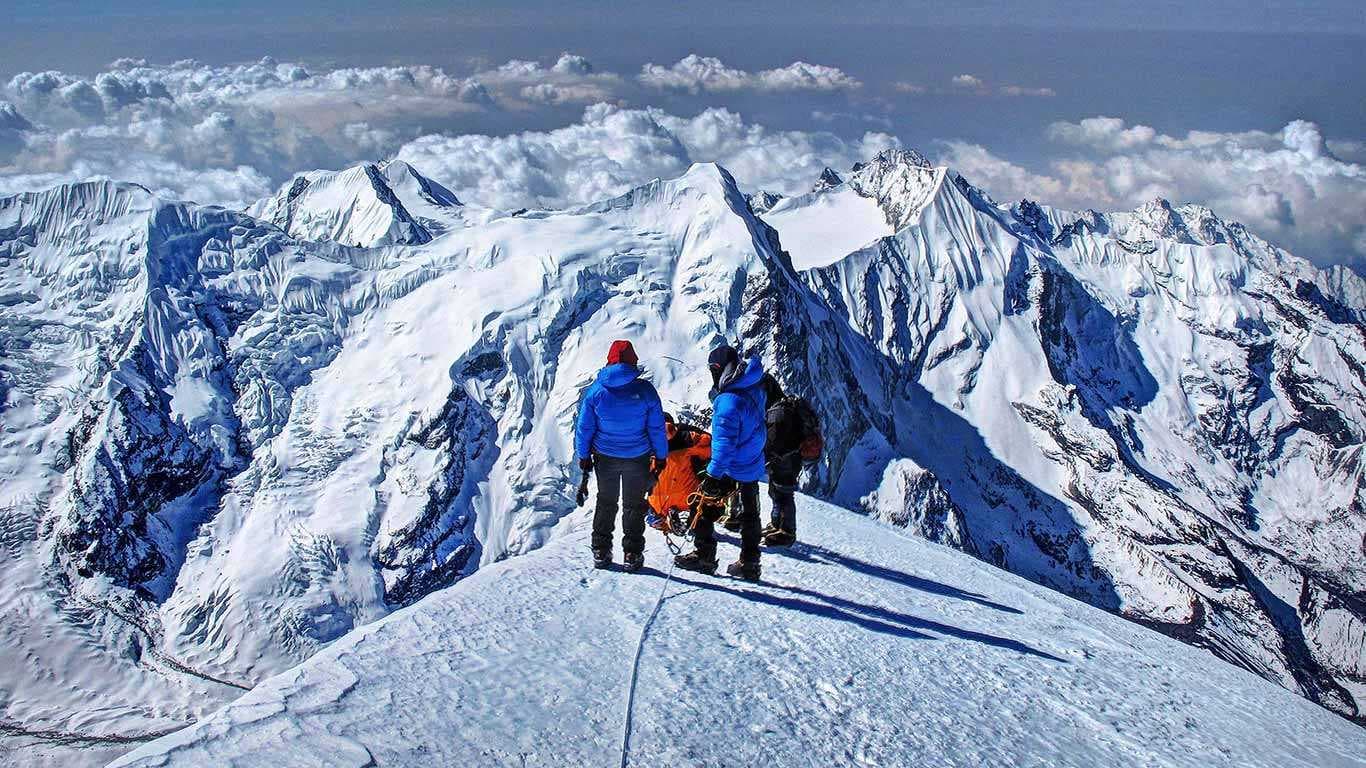
Mera Peak Climbing is one of the most famous peak-climbing journeys in Nepal. Mera Peak at 6,476 meters in the Everest Region is the highest yet straightforward trekking peak that is not on the technical side of Peak Climbing. Climbing Mera Peak is taken as practice or basic preparation and acclimatizing a bit to the higher altitude before attempting Mount Everest or other eight-thousanders.
The Mera Peak trail is an isolated off-the-beaten path that goes through the Hinku Valley. The first climbers of Mount Everest, Tenzing Norway Sherpa, and Sir Edmund Hillary, initiated the practice of ascending Mera Peak both before and after the Everest expedition. Since then, there has been constant excitement about its popularity, which has been rising over time.
Our 17-day climb to Mera Peak is an excellent option for beginners and those with moderate experience. Although the peak is at more than 6000 heights, climbing and technical skills are not mandatory, and we assure you that it is possible with proper guidance.
We begin by sightseeing the UNESCO World Heritage Sites of Kathmandu such as the Pashupatinath Temple, Boudhanath Stupa, Kathmandu Durbar Square, and Swayambhunath Stupa. Our climbing journey begins with a scenic flight to Lukla and heads towards Chhuthang, east of Lukla – through the forest. The next few days we head to Thuli Kharka followed by Kothe and Thangnak. Then after crossing several suspension bridges, we reach Khare, acclimatizing in between and preparing our mindset. Next, we head to Mera High Camp and finally attempt the summit of Mera Peak and return.
Mera Peak Climbing Highlights
- The summit of the highest trekking peak in Nepal, Mera Peak at 6476 meters.
- Captivating views of the eight-thousanders such as Mt. Everest (8,848 meters), Mt. Lhotse (8516 meters), and Mt. Cho Oyu (8,188 meters) along with many other smaller ones.
- Experience walking through the Himalayan wilderness and high passes
- Mountainous views across ancient monasteries, temples, and beautiful lakes
- The unique Sherpa culture, tradition, lifestyle, and hospitality
- Beautiful Sherpa settlements, Tibetan-Buddhism Monasteries, Chortens, and Mani Walls
Mera Peak Climbing Difficulty
The Alpine Grading System rates Mera Peak Climbing as Alpine Grade PD (slightly difficult) due to some technical sections and glacier climbing. However, it is not as challenging as the mountain expeditions. There are a few factors that make the Mera Peak Climbing difficult.
There are three routes to Mera Peak Climbing. The difficulty level differs from the routes. This package is designed with the shortest and the most difficult route that starts straight from Zatr La Pass once we land in Lukla. This route includes rough terrains, along glaciers, and crevasses which is fit only for experienced trekkers.
The greatest challenge of ascending Mera Peak is its high altitude. If given access to a carefully planned route, suitable acclimatization, a contingency day, and training, the danger associated with the climb can be reduced. You should follow a slow, deliberate approach up the mountain to give your body more time to adjust to the rising altitude. It's also crucial to stay warm, dry, hydrated, and well-fed to be in the best condition on summit day.
Best Time to do Mera Peak Climbing
Although Mera Peak Climbing is possible throughout the year, we advise starting your journey in the spring or fall when the beauty of this walk is at its most breathtaking.
Spring in the Mera Peak region starts in late March and lasts till early May when the trekking trails offer some of the most beautiful views of the year of the mountains, thick forests, vibrant meadows, and flowering rhododendrons. The weather during the spring days is bright, sunny, and warm with pleasant temperatures. However, the early spring months have slightly cold nights being the post-winter months.
While spring is a great time, autumn is the best time for Mera Peak Climbing. With the departure of the Monsoon season, the weather will be dry yet the vegetation will remain green and rich. The skies will be clear with the best visibility of the mountains, landscapes, and valleys from the trekking trails as well as the Mera Peak Summit. The autumn in the Mera Peak region starts in October and lasts till November.
Generally, the monsoon/summer and winter seasons are referred to as the off-season for the Mera Peak Climbing journey.
After the downpour, the skies and mountain views are at their best but the trails will be muddy and dangerous and may result in failure. Also, there are chances of avalanches and landslides making the trip unsafe. But if you are determined to undertake it during the monsoon, choose either late September or early June and go with extra preparation.
With the arrival of December, the Himalayan region gets ready to welcome the driest and coldest season, winter. The temperature starts to drop drastically, especially during the nights at the higher elevation. The aftermath of the heavy snowfall might block the trekking paths. However, it is doable to attempt with the proper planning, tools, and assistance from a certified climbing guide, especially in early December. If you appreciate solitude and quiet landscapes, December is the best month for trekking.
Permits to do Mera Peak Climbing
Climbers are required to obtain the following permits to climb Mera Peak for the mentioned route in the itinerary.
1. NMA (Nepal Mountaineering Association) Permit
4. Makalu Barun National Park Entry Permit
All these permits are included in the package cost.
Read More: How to obtain Mera Peak Climbing Permit?
Itinerary Detail
What is Included / Not Included
- All Arrival/Departure transfers as per itinerary
- 3* standard category hotel accommodation on a twin/double sharing basis with breakfast in Kathmandu
- Guided sightseeing in Kathmandu
- All Heritage Entrance Fees as per the itinerary
- English Speaking City Guide
- Private Transfer for sightseeing in Kathmandu
- Domestic (Kathmandu – Lukla – Kathmandu) Airfare and taxes as per itinerary
- All Guest houses, Lodge, and Tented Accommodation during the Trek and Climb
- All meals (Breakfast, Lunches & Dinner with Tea/Coffee) During the Trek & Climb
- An Experienced GOVT licensed Trekking, Climbing Guide & required No. of Sherpa Porters
- All wages, allowances, insurance, medical, and equipment for the guides & supporting crew
- Sagarmatha (Everest) National Park Fees
- TIMS fees & Local Province (Municipality/Village) Fees
- Peak Climbing fees (Royalty)
- Climbing & Camping Equipment as per itinerary/necessary
- Garbage fees/a comprehensive medical kit
- Welcome/Farewell Dinner
- All applicable Government and local taxes
Accommodation during the Mera Peak Climbing
Himalayan Trekkers provides 3-star standard category hotel accommodations in Kathmandu on a twin/double sharing basis. However, you have a wide range of selections from 3 to 5-star hotels, basic lodges, and even hostels. You can also opt. for the single supplementary at an additional cost.
During the trek and Mera Peak Climbing, you will be spending the nights in the trekking teahouses with minimal amenities. The rooms will be furnished with a bed, mattress, blanket, and pillow as a bare minimum on a twin-sharing basis. In the upper locations, you might have to share the restrooms and toilets.
Similarly, in areas where trekking lodges and teahouses are not available, we provide lodging in tent camps.
Meals during the Mera Peak Climbing
Himalayan Trekkers will offer all three meals—breakfast, lunch, and dinner—except the lunches and dinners in Kathmandu, which have a wide variety of dining options.
After Namche Bazaar, your options become increasingly limited. The most well-known dishes in Nepal are noodles, dumplings, flatbreads, potatoes, fried bread, mushroom soup, butter tea, and the staple, Dal-Bhat-Tarkari (lentils, steamed rice, and seasonal vegetables).
Whenever we use tented accommodations, our tent cooks will provide you with freshly cooked meals.
Drinking Water during the Mera Peak Climbing
When trekking for more than 4 to 5 hours each day in high altitudes, drinking water is crucial. Fluid intake should be increased because dehydration is a very typical occurrence. Bottled water is available, although it can cost twice as much at higher altitudes. You can thus bring a filtering flask or purification pills in addition to a reusable water bottle and fill it up at the various natural springs and taps you come across along the way. Boiling water is available in tea shops, although it costs extra per liter or pot.